
Where Should an Insect Killer Be Installed? Does Installation Location Affect Trapping Performance?
After purchasing an insect killer, choosing the right model is important, but another question is often overlooked: Where should the insect killer be installed?
Many people assume that simply installing an insect killer indoors is enough. In reality, installation location, surrounding light sources, space layout, and flying insect activity can all affect trapping performance.
Choosing the right location is therefore an important part of using an insect killer effectively.
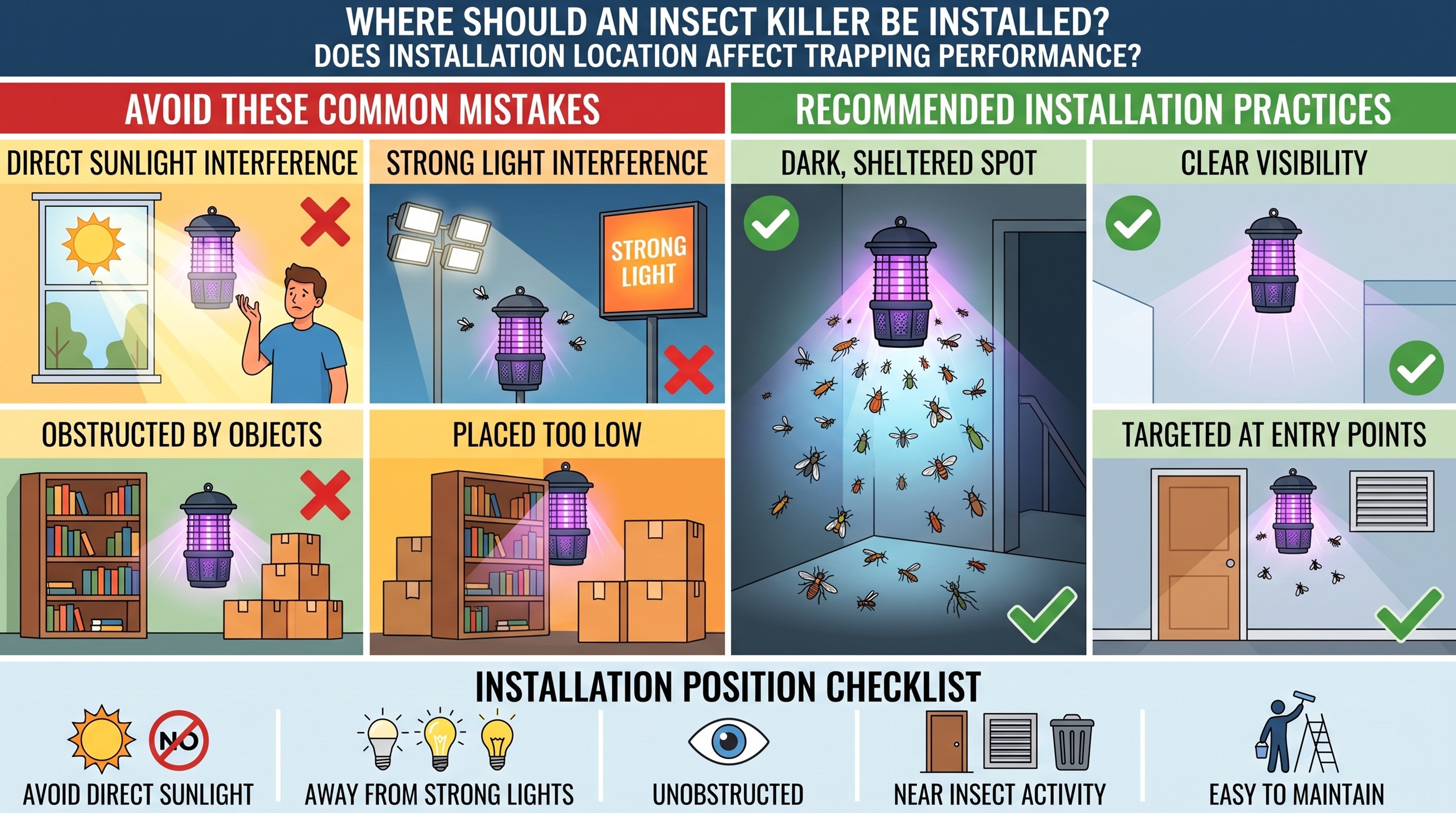
Why Is Installation Location Important?
An insect killer generally uses UVA light to attract flying insects, which are then captured using either a glue board or an electric grid.
If the insect killer is installed where it is exposed to direct sunlight or strong competing light sources, or if it is blocked by shelves, machinery, or other objects, flying insects may be less likely to approach the unit.
For this reason, installation should not simply be based on finding an available space. The surrounding environment and areas where flying insects are likely to move should also be considered.
1. Avoid Direct Sunlight
In general, insect killers should not be installed in areas exposed to direct sunlight.
For example, areas near large windows, skylights, or open spaces may have strong ambient light during the daytime, which can reduce the attraction of the UVA light source.
If the area has strong natural lighting, consider a location with less direct light and reduced exposure to sunlight.
2. Avoid Strong Nearby Light Sources
In addition to sunlight, outdoor lighting, illuminated signs, and other strong light sources may interfere with the attraction of flying insects.
Before installation, check whether there are strong light sources operating near the insect killer.
If there is a bright light source nearby that remains on for long periods, consider adjusting the unit's location to reduce potential interference.
3. Keep the Insect Killer Unobstructed
Large machines, shelves, cabinets, and other equipment can block the light from an insect killer and may affect its attraction range.
This is particularly important in food factories, warehouses, and restaurants where equipment and storage areas are often present.
Leave sufficient space around the unit not only to maintain good visibility of the light source, but also to make routine cleaning, inspection, and glue board replacement easier.
4. Consider Where Flying Insects Are Likely to Enter
When planning the installation location, it can be helpful to consider where flying insects are likely to enter or move through the space.
✔ Near doors and windows
✔ Around entrances and exits
✔ Near ventilation openings
✔ Around waste storage areas
✔ Near food preparation areas
These areas can be considered when selecting a suitable location.
However, placing an insect killer as close as possible to a door or window is not always the best solution. The surrounding lighting, workflow, and overall space layout should also be taken into account.
5. Restaurants and Food Factories Require Careful Planning
Restaurants and food factories often have more comprehensive flying insect management requirements. Therefore, the location of insect killers should consider not only trapping performance but also daily operations and hygiene management.
For example, avoid locations where the unit could easily be bumped or damaged, and make sure it remains accessible for routine inspection and cleaning.
In food preparation areas, installation should be planned according to the specific environment and hygiene requirements, together with proper door and window management, cleaning, and control of potential insect sources.
How Can You Tell If the Installation Location Is Suitable?
After installing an insect killer, regularly observe its trapping performance as part of routine inspections.
If the unit is operating normally but captures very few insects over time, check the following:
✔ Is there a strong light source nearby?
✔ Is the unit exposed to direct sunlight?
✔ Is the unit blocked by equipment or other objects?
✔ Is it located near areas where flying insects are active?
✔ Are there other sources of flying insects in the environment?
If necessary, adjust the installation location according to the conditions of the site and continue monitoring the results.
Quick Installation Checklist
| Installation Condition | Recommendation |
|---|---|
| Direct sunlight | △ Avoid if possible |
| Near strong light sources | △ Avoid if possible |
| Blocked by large equipment | △ Consider relocating |
| Near areas where insects enter or are active | ✓ Consider as a priority |
| Easy access for cleaning and maintenance | ✓ Recommended |
WELL Reminder
An insect killer is not simply a device that can be installed anywhere and expected to work equally well. The installation location is one of the important factors affecting trapping performance.
If an insect killer is operating normally but trapping results are lower than expected, first check the installation location, surrounding light sources, and environmental conditions before checking the lamp and glue board.
Proper equipment placement, regular maintenance, and environmental management can help maintain more consistent insect trapping performance.
• Why Is My Insect Light Trap Not Catching Mosquitoes? Common Causes and Solutions
WELL Electronics | 40 Years of Professional Commercial Insect Light Trap Manufacturing
Specializing in commercial insect light traps, glue board insect light traps, electric grid insect light traps, flying insect control solutions for food processing facilities, and OEM/ODM manufacturing services. We help businesses establish cleaner, safer, and more effective flying insect management environments.