
Why Is My Insect Light Trap Not Catching Mosquitoes? Common Causes and Solutions
You have installed an insect light trap, but there are still plenty of mosquitoes while only a few insects are caught on the glue board?
Insect light traps not performing as expected does not necessarily mean that the equipment is faulty. The results may also be affected by mosquito behavior, lighting, installation location, and environmental conditions.
Can Insect Light Traps Really Catch Mosquitoes?
Insect light traps primarily use the phototactic behavior of flying insects to attract them with specific light wavelengths and then capture them with glue boards or other trapping methods.
However, different flying insects respond differently to light. When mosquitoes search for hosts, they are also influenced by carbon dioxide, body temperature, human odors, and environmental conditions.
Therefore, an insect light trap is an environmental flying insect management device and should not be relied upon alone to solve all mosquito problems.
Why Isn't the Insect Light Trap Catching Mosquitoes?
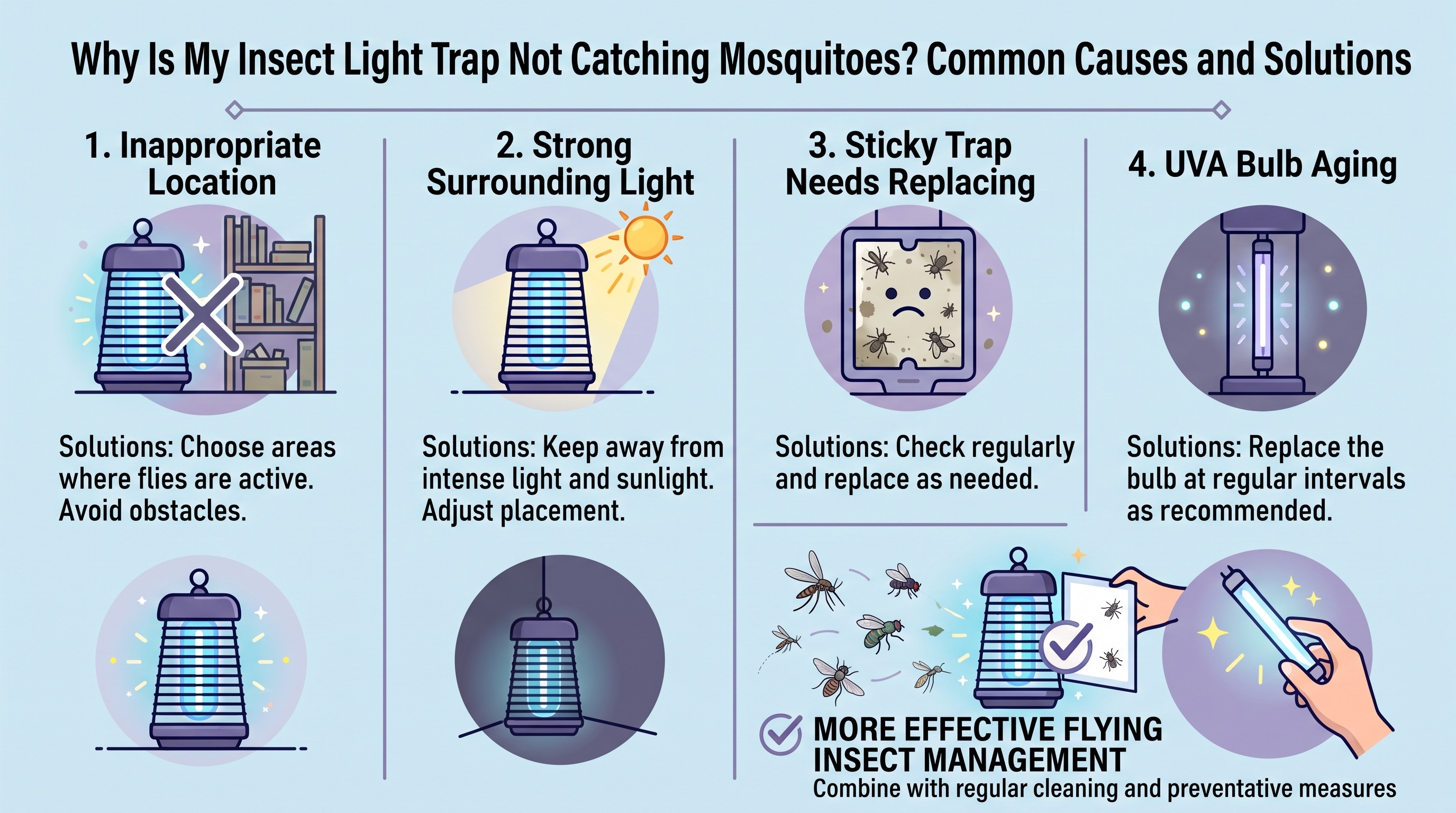
1. The Installation Location Is Not Suitable
If the insect light trap is placed in a corner, blocked by objects, or exposed to strong airflow, flying insects may be less likely to approach it.
How to improve:
Choose a location where flying insects are likely to be active, while avoiding obstacles and strong airflow.
2. There Is Too Much Surrounding Light
Sunlight, outdoor lighting, or other strong light sources may reduce the attraction of the insect light trap.
How to improve:
Avoid installing the unit next to strong light sources and adjust its position according to the surrounding environment.
3. The Glue Board Needs to Be Replaced
Glue boards that have been used for too long or are covered with dust, oil, or large numbers of insects may have reduced trapping effectiveness.
How to improve:
Check the glue board regularly and replace it according to actual usage conditions.
4. The UVA Light Source Has Aged
Even if the lamp is still working, its performance may gradually decline after prolonged use, which can affect its insect-attracting effectiveness.
How to improve:
Check how long the lamp has been in use and replace it according to the product's recommended replacement cycle.
5. Mosquitoes May Not Be Easily Attracted
In addition to light, mosquitoes use carbon dioxide, body temperature, and human odors to locate hosts.
Therefore, if mosquitoes are the main concern, inspect potential mosquito sources such as standing water, damaged screens, doors, and windows in addition to using insect trapping equipment.
Five Things to Check When an Insect Light Trap Is Not Performing Well
① Is the installation location suitable?
② Is there strong light interference nearby?
③ Is the installation height appropriate for the product?
④ Does the glue board need to be replaced?
⑤ Has the UVA lamp been used for too long?
After identifying the problem, adjust the equipment and environment accordingly. This is generally more effective than simply increasing the number of insect light traps.
Commercial Facilities Need to Pay More Attention to Installation and Maintenance
Restaurants, food factories, central kitchens, supermarkets, and other commercial facilities need to consider not only the equipment itself but also traffic flow, entrances and exits, surrounding light sources, and areas where flying insects are active.
Using suitable glue board insect light traps, together with regular equipment inspections and glue board replacement, can help continuously monitor flying insect activity in the environment.
An insect light trap is one part of an overall flying insect management program and should be combined with routine cleaning, door and window management, and other insect control measures.
WELL Reminder
If an insect light trap is not catching mosquitoes, it does not necessarily mean that the equipment is ineffective.
Installation location, surrounding light sources, glue board condition, UVA light performance, and mosquito sources in the environment can all affect the results.
Rather than simply adding more equipment, it is better to identify the problem from three aspects: equipment, installation, and environment. This can help improve overall flying insect management.
Conclusion
For an insect light trap to perform effectively, choosing the right equipment is important, but proper installation and regular maintenance are equally important.
Good equipment management, combined with environmental cleaning and insect control measures, can help establish a more comprehensive flying insect management program.
• Home Insect Light Traps vs Commercial Insect Light Traps: What's the Difference?
WELL Electronics|40 Years of Professional Insect Light Trap Manufacturing
Specializing in commercial insect light traps, glue board insect light traps, electric grid insect light traps, flying insect control for food factories, and OEM/ODM manufacturing services, helping businesses establish a more comprehensive flying insect management environment.